iStock_000017785306Small.jpg

Youth Sports: The Best Way To Recover From Injuries

« Blog | Written by ezfacility | | (0) Comments |

Many youth athletes today would rather play through the pain than miss a practice or a big game. They’ll ignore an injury and hope that it will just go away with time. Unfortunately, neglecting an injury usually leads to an overuse or repetitive trauma injury and can, in extreme cases, affect the player’s ability to play at all.

Overuse injuries are caused by repetitive stress on the muscle and skeletal system without enough rest to allow the body to adapt. Young athletes are especially at risk as their bodies are still developing. Most of these injuries occur during adolescent growth spurts.

As a direct result of the rise in repetitive trauma injuries in young athletes, sports medicine experts are now urging a larger role for athletic trainers at schools and sports facilities. With an effective rehabilitation program, highly trained athletic trainers can help players recover and avoid lasting damage or interrupting the competitive sports schedule. Facilities should look to include more trainers that specialize in sports-related injury and rehabilitation to their staff to ensure the proper recovery of their players. In a recent study conducted by the American Medical Society for Sports medicine, they recommend that facilities enforce preventative training and conditioning regimens, scheduled rest periods and requiring a pre-participation physical exam to assess a player’s ability to play. They also suggest enforcing limits on repetitive motions such as pitching and hitting as well as identifying any injuries certain athletes are prone to.

John DiFiori, head of the division of sports medicine at the University of California Los Angeles indicates that these preventative exams, “…gives parents a better basis for making a decision about their child’s participation”. In other words, if the assessment indicates that their child is prone to repetitive injuries, they may want to consider enrolling their child in an alternative sport.

Access to athletic trainers in school sports programs has doubled over the last 20 years, but only about a third of high schools have full-time professionals on staff, according to the National Athletic Trainers Association. Moreover, many community programs such as soccer and gymnastic leagues don’t have athletic trainers on board. Some states are considering legislation to require a medical professional be present at high school sporting events.

With more athletic trainers on staff, the better the chances are of avoiding an overuse injury in young athletes before they turn into a serious medical issue. For example, if a trainer catches an injury in time, he can put the player on a daily routine of stretching and applying hot and cold therapy with an electrical stimulation device to improve blood flow to muscles to reduce pain. Additionally, during practices, the player may be instructed to kick fewer balls, pitch a little less, hit less, etc., as well as rest for a few days after each game.

The key to avoiding overuse injuries is to catch them before they worsen. Unfortunately, in most cases, the player will let the injury get worse before seeking professional help. The goal of sports organizations and facilities should be to incorporate more athletic trainers into the overall sports program to prevent these injuries from occurring in the first place.


yoga.jpg

Improving Air Quality In Fitness Facilities

« Blog | Written by ezfacility | | (0) Comments |

Your face is red, your muscles are burning out, but you will be darned if you drop that weight before you hit 20 reps. What are you (and your trainer) telling yourself to do at this point to keep going?

“Remember to breathe.”

Proper breathing is critical to your fitness success (and, well, living in general). It’s especially important in classes such as Yoga and Pilates where the focus is predominantly on breathing. However, those deep “cleansing” breaths may not be as clean as you think. In many gyms, aside from oxygen, you are also breathing in carbon monoxide, carbon dioxide, ozone, dust, cleaning chemicals and even formaldehyde.

A recent study measured the doses of these dangerous gases over the course of a month at peak hours of a select group of gyms. Researchers found that the high levels of pollutants collected exceed the indoor safety standards of air quality.

Yikes.

High levels of dust (kicked up from members going through the whole range of motions) and formaldehyde (yes, formaldehyde, as in the substance used to preserve dead animals) were the main culprits. However, the biggest concern was the levels of carbon dioxide (CO2) measured, that are just a natural effect of all that healthy exercise. The problem is that all this healthy exercise is happening in a (usually) small, confined space, like an aerobics studio. When we breathe during exercise, we are mostly breathing through the mouth and this means the air is not being filtered through our nostrils, causing this polluted air to get sucked deeper into our lungs.

Now, as horrific as this sounds, there is a simple solution for gym facilities: ensure there is proper ventilation. People are not going to stop coming to the gym to work out—especially when it’s colder than the arctic outside—but this should be a wake-up call for gym and sports facilities. Ensuring proper ventilation and paying closer attention to the cleaning products you use can go a long way in improving air quality. Mopping instead of sweeping the floors will also help to reduce the amount of dust.

There are many solutions facilities can use to improve their air quality. Do your research and make sure you are providing a healthy place for clients to work on their fitness!

iStock_000058861576_Small.jpg

Navigating the Shuffle

« Blog | Written by ezfacility | | (0) Comments |

When you think about it, there are a lot of shuffles out there. There is the IPod shuffle, the playing card shuffler, and even a dance called the Cupid Shuffle! However, as a gym and health club owner the worst shuffle you may be all too familiar with is the shuffle clients and prospective clients can get lost in. So, let’s chat about how technology can act as the light at the end of the tunnel.

Prospective Clients

To be honest, new clients sometimes get lost in the shuffle. As much as you would like to think it doesn’t happen, it does. In fact it is pretty easy to lose someone you do not know much about. Think about it ; they are able to come and go from your gym with ninja stealth because the only thing that even resembles a record that they were there was that paper flyer you handed out at a local café offering a free pass. However, if your front desk is not paying attention or the pile of flyers is lost, then so are your records. With gym management software that has a strong CRM component, being able to not only report on who walked through the door, but what they did and where they spent their money is a vital tool. So it should be obvious that having a strong CRM is key, but let’s also talk about hanging paper flyers. With so much business being done online it is essential that your gym management software also contain the tools to get your business online. Having an online portal where clients can go to register eliminates the need to manually enter prospects into the system and allows for a place clients can peruse current facility offerings, and even see a full list of available classes. With potential clients being far more educated now than at any other given point in history, providing them the tools to educate themselves can go a long way in getting them to visit your facility. Having the client do a bulk of the “heavy lifting” at home ensures they are not just another paper in the stack.

Current Members

After learning about prospective clients you may be thinking how could I lose current clients—I have all of their information already! Gaining client information is important; however, gaining the right information is even more so. An overwhelming fact we should all be able to agree upon is that current clients have extremely valuable information—you just need to know how to organize and access it. Sure, you can tell how much your members are paying from your bank statements, but this can be both time-consuming and rarely gives you any insight into the success or failure of the products and services you offer. With competent software, not only can you track how much each member is paying, you will also have immediate access to an array of crucial information including clients with expiring memberships, clients with class packages that are about to run out and, most importantly, who’s memberships or packages have already expired. Think about it, every package that goes un-renewed or sits expired is, for the most part, money left on the table. Strong software will provide notifications and ample reporting to keep the business owner always in the know. For example, “ALERT: Bryant has 1 session remaining on his Personal Training 10-Pack” may be an inconvenience in terms of the email, yet the possible return is well worth it. Furthermore, with a POS system, you can associate purchases with clients. Although it may be something as simple as a Gatorade with every Zumba class, that info creates a buying profile for the client. Once you know what products a client prefers you can expand upon those offerings and sell more! Without management software, you may struggle to track these critical variables that help you smoothly manage your business. How do you know that John Doe, whom you see every Monday come in for this 5:30 workout is paid up on his membership? With management software, your staff is able to access a client’s history with the touch of a button.

If you think about it, the ultimate goal—for a gym or health club –is to gain more clients and, in turn, gain more money. A huge key to that principle is not only attracting, but also signing prospective clients. Yet, a lot of businesses can find themselves struggling with this due to poor tracking. From tracking interested prospects coming into a facility to tracking what prospects are doing and buying — Gym Management Software can be a great way to ensure no one gets lost in the shuffle.


iStock_000024919842Small.jpg

Maximise Your Treadmill Area

« Blog | Written by ezfacility | | (0) Comments |

Maybe 2015 was the year of the treadmill. The cardio-room classic was in the news a lot last year, made prominent especially because of the tragic death of Dave Goldberg, who was the CEO of SurveyMonkey and the husband of Facebook’s Sheryl Sandberg. Goldberg was exercising on a treadmill at a gym when he lost his grip on the railings, fell backward, and fatally hit his head. After that, news outlets and social media channels were buzzing with concerns about treadmill safety, and stats from the government’s Consumer Products Safety Commission were frequently cited: 24,400 people in the United States visited hospital emergency rooms because of treadmill accidents in 2014. Between 2003 and 2012, thirty treadmill-related deaths were reported. Nevertheless, at the end of the year, IHRSA released a Consumer Trend Report which found that treadmills are — still, after many decades and many accidents — the most popular form of equipment-based exercise among health club members.

So maybe every year is the year of the treadmill. It’s interesting to consider why the machine remains so popular, especially in the face of new exercise technologies and new research about more efficient ways to exercise. The first thing to note is that the treadmill has a long history, much longer than most people realize: The first treadmills were invented around 4,000 years ago, one of man’s earliest machines. They were used to transport water; much later they were put to work powering dough-kneading machines, bellows, turbines, and other industrial equipment. In the 19th-century, as technology developed and treadmills were no longer the most efficient machines in the factory, they were used as devices of punishment: Prisoners in European countries were made to walk them as retribution for their crimes.

Of course, sometimes they still feel like a punishment. But exercisers keep coming back to them. They became what they’re known as in their current incarnation in the late 1960s, when a mechanical engineer, William Staub, read the book Aerobics, by Dr. Kenneth H. Cooper. The home treadmill was born, and over the past forty or so years it has evolved into the machine everyone keeps coming back to. So what does keep them so popular? First of all, the time-savings factor. Obviously, home-users can just hop on or off, and even walking on a treadmill at a moderate pace for 20 minutes a day can help them stay in shape. At your facility, same thing: easy in, easy out — there’s very little time lost for a member who just wants to check in, bang out the treadmill routine, and get on with his or her day. Second, there’s versatility. Treadmills stay interesting because you can increase or decrease the intensity at which you use them, change the incline or speed, and experience a whole range of exercise activities with one relatively simple piece of equipment. Moreover, of course, exercisers can use them in any weather. Another thing treadmills allow for that most other pieces of equipment do not is multitasking.

Users can watch television, send emails, read magazines, internet shop—any number of tasks can be performed while a workout still gets accomplished. And, finally, they’re easy to use. Unlike some exercise equipment, treadmills are simple; almost anyone can get on one and start using it without the help of an expert.

So, why is it worthwhile to ponder all this? Given the enduring popularity of treadmills, it’s important to consider regularly their role in your facility. Do you have enough of them? Are they simple enough? Up-to-date enough? Have you ever conducted a survey to suss out how your members most like to use them, or simply spent a few hours observing patterns of use? Do your treadmills stand in a sad row in some corner of your cardio room, or are they given the prominence their popularity suggests that they deserve? Use IHRSA’s latest Consumer Trend Report as a prompt to assess the treadmill situation at your facility, and figure out how to more actively use treadmills to your advantage.

iStock_000043957868_Small.jpg

Shifting the Focus from Retention to Sales

« Blog | Written by ezfacility | | (0) Comments |

Have you ever wondered if there’s really any point to your retention strategy? You offer everything under the sun, do double back-flips, and consider giving away your first-born any time a member tells you they’re ready to leave, and then they go ahead and leave anyway. Ever get the feeling that there’s just nothing you can do?

The fact is, everyone in the industry wonders, but it’s something we try not to acknowledge. We hold on to the idea that we must continually try new approaches and inexhaustibly explore all possible avenues, plus a few impossible ones, and never give up on the lofty goal of retaining 100 percent of our members. Well, what if that’s the wrong approach? What if, instead, we conceded that we never will retain 100 percent of our members, and that our energy would be better spent on other aspects of running our clubs? What if we actively prioritized new sales over member retention?

These are questions Rob Bishop and Barry Klein, owners of Elevations Health Club in Scotrun, Pennsylvania and regular contributors to Athletic Business magazine, hash out in a recent article for Athletic Business. Having focused on retention over sales for two decades — never employing salespeople or using high-pressure sales techniques — Bishop and Klein found themselves one day wondering why, despite all their daily concerted efforts to get members to stick with their gym, they nevertheless almost always lost the members they were expending energy to retain. As long-time gym owners, they considered their “retention program” nothing more than everything they did everyday and every dollar they spent on their staff, facilities, and programming. As they put it, “Is your club clean? Are people greeted properly? Are members well-integrated into your facility with training programs, group fitness classes, seminars and other offerings?” Those elements, along with other offerings vital to the success of any club, are critical for keeping any member signed up for any length of time, they argue.

Given that, they realized that most members “cancel for reasons that are beyond our control — relocation, financial reasons, work conflicts. And while reasons such as ‘no time’ might be shorthand for ‘I don’t want to be a member anymore,’ it’s clear to us that once someone has crossed that threshold, we are not going to bring them back.”

If that’s the case, they ask, what can gyms do? The answer may lie in shifting the focus of your business premise, so that rather than privileging retention, you start thinking more about sales. “Our point isn’t to give up,” they write. “It’s to focus on something we think we can more directly impact and to some degree control.” Thus, Bishop and Klein are trying out a “sales focused” approach that aims to attract many happy members. Basically, they consider happy members ambassadorial assests — vital elements of the community who spread the word to new potentially happy members. It’s a subtle shift, but focusing more on sales than retention — while still aiming to keep members as happy as possible from day to day — allows the duo to value referrals even more than a forever commitment from a member (which, they say, is an ideal that doesn’t exist). For example, if the stated purpose of “bring a friend” event is to acquire new members rather than to keep existing members engaged, they now might find themselves, if spots are limited, turning away a member in favor of a guest. This isn’t something they ever would have done previously.

That’s not to say it isn’t still worth trying to keep members forever. Who knows? Perhaps it’s possible and the industry just hasn’t yet discovered the right lever or formula? Still, it might be worth exploring strategies that are potentially more realistic — if for no other reason than achieving greater peace of mind. “The real difference will be this,” Bishop and Klien write. “When a member who has sent us 10 referrals suddenly cancels, we’re not going to stress about it anymore…. The trick is to have a gym full of happy members, regardless of how long they are with us.”

iStock_000024271168Small.jpg

What's All The Rage Report

« Blog | Written by ezfacility | | (0) Comments |

What’s all the rage? Last month, IHRSA, the American Council on Exercise, and ClubIntel released a report exploring the answers to that question as it relates to the offerings of fitness professionals and gym operators around the world. Aiming to shed light on the equipment, programs, services, and technology the fitness industry adopts, the report (actually titled What’s All the Rage?) also looks at how adoption rates of various trends change over time. In particular, the report examines trends in three categories: programs, services, and training protocols; equipment and facilities; and technology.

Why should you pay attention? The groups that published the report gathered behavioral data from more than 11,000 health and fitness businesses around the world. The sheer number of industry players providing input makes it worth checking out. Moreover, understanding which trends are emerging, niche, growing, maturing, or declining can help you make key business decisions.

Okay, so then, what is all the rage? Here are some highlights from the report, as summarized by Club Industry:

• Of any program or service in the fitness industry, personal training has the highest adoption rate.

• The hottest equipment and accessories? Given the popularity of CrossFit and other functional fitness methods, it may not be surprising to hear that traditional equipment and accessories top the list. We’re talking medicine balls, BOSU, stability balls, and the like. Flexibility/mobility equipment is equally hot. Think foam rollers, stretch trainers, and myofascial release devices.

• It’s been a few years now that we’ve been hearing about HIIT group exercise classes, boot-camp programs, functional resistance training, and small-group training. There’s a reason why. These approaches have all achieved a high level of adoption and continue to show above average growth.

• It’s also been a few years — or more than a few — that we’ve been hearing about technology as the fitness industry’s Next Big Thing. But, surprisingly, social media is the only well-adopted technology trend. Technology-driven innovations such as online pricing transparency, online registration and reservations for programs, selling memberships online, virtual training and club mobile applications have been minimally grasped by the industry. Over the course of the next decade, we’ll probably see greater adoption of such opportunities.

• Among the top ten most frequently adopted industry trends? Senior fitness programs. Keep adding programming for the silver-haired set. They’re only growing as a demographic and as a powerful, enthusiastic, and commited group of exercisers.

• Despite the production of a host of newfangled machines, two old standbys — treadmills and elliptical trainers — have experienced resurgence in growth in the past two years.

Take a look at the report and ponder the trends your facility has adopted. Are you in line with the majority? Is there a trend you’ve overlooked? Perhaps you should consider adding more senior programming or getting behind a technological innovation you haven’t tried yet. Or maybe you’re using technology that the industry really isn’t ready for. Whatever the case, it’s good to have a sense of the larger playing field, and to know where you stand on it.

iStock_000041146310_Small.jpg

Customer Service: One of the Most Important Features of a Software Solution

« Blog | Written by ezfacility | | (0) Comments |

For most fitness businesses that employ a comprehensive software solution, it’s impossible to imagine day-to-day operations without that solution. And these days, it’s almost impossible to imagine a fitness business that doesn’t use a software solution. Fitness facility management software allows for the optimization of resources; the streamlining of daily tasks; the automation of payments, reports, and communication; and the maintenance of member profiles and marketing efforts — among countless other benefits — to a degree that simply can’t be achieved without software. Yet, what good is any of that if the program you’re using fails in the customer service and support department?

Even if you’ve got the absolute best-performing software solution imaginable, if that solution doesn’t provide a top-quality customer service department for training, support, and troubleshooting, it’s ultimately not worth much. This is the case in all industries, but it’s especially key in the fitness industry, in which software solutions are so integral to the running of all aspects of a business that the customer service you provide depends on how well your software is running. If there’s a glitch, or if you just have a simple question, you have to know that troubleshooting is available immediately and efficiently.

How do you judge the quality of a software program’s customer service? First, check out the product’s website. The support feature should be prominent and available with a single click, and it should quickly and clearly explain how to reach a customer service representative. Ideally, it offers both a phone number to call and an online form you can submit. If you fill out an online form, you should receive an answer promptly. Both online and phone responses should be polite, friendly, and helpful, and the representative you’re dealing with should bend over backwards to make sure your questions are answered and your needs are fulfilled, and that you’re walking away a satisfied customer. If any of these elements are not in place — you can’t find the support page easily on the website, there’s no phone number to call, there’s a number but your call is handled incompetently, you submit an online request and do not hear back within 24 hours — you might be using the wrong software.

In addition, your software support team should offer training. There should be online courses that quickly, clearly, and effectively show you, the end user, how to optimise the product, and there should be opportunities for personalized training support. Again, if the product you use does not offer these customer service basics, you’re probably using the wrong one. After all, what good does your software do you if you don’t properly understand how to use it?

Ultimately, the management software solution you purchase should be backed by a company that employs an easily reachable team of dedicated, knowledgeable professionals who genuinely care about your business. If it’s lacking in that department, you would do well to seek out a software package that fulfills that most basic of business needs: help and support.

iStock_000013411771Medium.jpg

Your City’s Fitness Ranking Offers a Platform for a Great Message

« Blog | Written by ezfacility | | (0) Comments |

It’s that time again — the time when the American College of Sports Medicine (ACSM) publishes its annual American Fitness Index (AFI) Data Report. Funded by The Anthem Foundation, the AFI Data Report ranks the country’s 50 most prominent metro areas in terms of fitness, using such health and community indicators as variety of outdoor exercise options and rates of smoking, obesity, and diabetes. In this latest report, the eighth annual, Washington, D.C., Minneapolis-St. Paul, and San Diego scored as the top three fittest cities in the United States.

If you own or manage a fitness facility or sports center in one of these cities, congratulations. And congratulations to denizens of San Francisco, Sacramento, Denver, Portland (Oregon), Seattle, Boston, and San Jose, the other cities that scored in the top ten.

Whether your facility operates in a place on that prestigious list or not, the report’s publication offers an opportunity to consider how you might use it to drum up business. Do you run a yoga studio, gym, baseball center, ice rink, or other similar facility in Washington, D.C.? If so, create a new advertising campaign that shouts out your pride at living in the country’s fittest city. Light a fire under potential new members by inviting them — through posters, public transportation advertisements, emails, and social media blasts — to get on board and be a part of the fittest city movement. Or host a street fair or other kind of festival to celebrate the Number One designation, being sure to offer non-members plenty of chances to sign up for classes and memberships.

If you’re not in D.C. but your city did make the top ten, make that known to members and non-members. Don’t assume that anyone has heard the news — it’s unlikely that word has reached folks not in the fitness industry. This is a good thing, as it puts you in a position to educate your clientele (and potential clientele), using the information to motivate them to help improve your city’s ranking. Send a positive message: We’re good, but we could be better.

And if your facility is in Oklahoma City, Memphis, or Indianapolis, the three cities that scored lowest on all indicators? Take heart. You too are presented with a great opportunity to educate current and future members about the report’s existence, its meaning, and the fact that your city can work hard to land a higher place on the list next year or the year after. Adopt a serious tone and let people know there’s hope. Use the results of the report as a platform for encouraging more exercise among individuals, better local policies that might lead to a decrease in diseases related to sedentary behavior and an increase in exercise venues and options, and greater community support for health and fitness. Your clientele will become better educated and possibly more motivated, and your facility will get its name out there — and attached to a great message, to boot. Check out the AFI report, get your marketing people working on an effective campaign, and start spreading the word today.

iStock_000065160915_Small.jpg

Understanding What Makes Your Members Tick

« Blog | Written by ezfacility | | (0) Comments |

Recently, my son and I were in an old-curiosity-shop kind of store on a quaint little Main Street. It was the kind of place seemingly designed to ignite the imagination of a nine-year-old boy, full of tomahawks and fishing equipment, moccasins and hiking boots, old-fashioned toys, unidentifiable objects, kitschy souvenirs, wind chimes. We’d spent nearly an hour poking around in there, and I was on parenting auto-pilot: “Mom, can I have this?” “No.” “Why not?” “Because.” “Mom, can I have this?” “No.” “Why not?” “Because.” Finally, my son stomped his foot and shouted in frustration, “Don’t just say because!”

What struck me was his reason for getting frustrated: It wasn’t so much that I was saying no to most of the junk/treasures that he wanted to purchase, it was that I wouldn’t give him reasons for my refusal. When I looked him in the eye and explained how I felt — the real feelings behind my “no” — he relaxed. We left the store with just a tomahawk (don’t worry, it’s wooden) and a better understanding between us.

All of this was still on my mind when I was reading IHRSA’s blog the other day, and I stumbled on an article about the best ways to understand a prospective’s motivations for seeking a health club membership. The fact is, when we understand another person’s reasons — when we have more from them than just a “because” — we’re able to make things happen. My son could calm down and accept my refusal to buy him all the things he wanted when he understood why I was refusing. You can make sales to prospectives more effectively and up your member retention when you understand why your clients are seeking — (or renewing, or considering giving up) — membership. As Casey Conrad Tamsett, President of Communication Consultants in Wakefield, Rhode Island, puts it on the IHRSA blog, “If you don’t know why a guest happens to be standing in front of you, or what a member wants from your club, how can you possibly meet their needs?”

The question is, how do you go about discovering your prospectives’ and members’ true motivations? Justin Tamsett, Managing Director of Active Management in Sydney, Australia, advises, “In your first face-to-face conversation, when asking about them and their life, you need to show an authentic — not a feigned — interest.” In other words, you have to earn a client’s trust before being allowed to understand his or her true motivation. Earning that trust is a process, Tamsett says, one that begins with your staff’s commitment to making the moment of initial contact a special experience. “You need to convey the fact that you genuinely care about them,” he says. And that caring has to carry through, with every employee in the club working hard to regard the visitor as a guest.

Keep in mind, though, as Conrad warns, that most people purchase gym memberships not for logical reasons but for emotional ones. “Their ‘trigger,’ the factor that brought them to your door, usually is related to some significant personal experience,” she says. But that experience is hidden under layers. Conducting a needs analysis, in which you peel back the layers with careful questions, gives prospective clients a chance to open up. You have to spend the time listening until you get to the feeling that prompted action — just like my son had to spend the time listening to my underlying feelings in order to understand my reasons for saying no. Of course, it’s a give-and-take: I had to be willing to reveal my underlying feelings to my son before he could listen to them. But if you create the right environment in your facility, one in which the client is respected as more than just a commission score, one in which employees work hard to gain clients’ trust and form true relationships with them, the willingness to open up will come naturally. And the opening up will lead to more successful business operations.

iStock_000029606292_Small.jpg

Enabling Accessibility

« Blog | Written by ezfacility | | (0) Comments |

At the climbing gym I frequent, there’s a man whose left arm ends in a stump. He’s a veteran who lost his hand in Iraq. I know how hard it is scaling those thirty-foot walls with all my limbs intact; watching this guy, I can’t help but feel humbled and awed. He does it with no special accommodations. He just figures out what will work for him, and up he goes.

Indoor climbing is especially flexible in this way — the whole point is to do what you have to do to get to the top, no matter what particular challenges you might be facing. But, what about other, less universally approachable sports or exercises? What about just watching sports? How can we make participating in sports, working out, and being a fan in the stands more accessible for anyone who wants to take part?

There are a few things to consider as you gauge your facility’s accessibility and think about what changes, if any, to make. First, there’s the ADA, or Americans with Disabilities Act. Enacted in 1990, this law requires public places and commercial facilities to comply with guidelines that allow for wheelchair accessibility and other disability considerations. Facilities constructed before 1990 are not required to meet the specific stipulations of the ADA — such as that wheelchair spaces be at least 36 inches wide, with equal, adjacent space for a companion — but such facilities are under obligation to remove existing barriers. And any facility refurbishing its space must bring it into ADA-compliance.

So, for example, when Hampton-Dumont High School in Hampton, Iowa, decided to replace its fifty-five-year-old wooden bleachers recently, it had to create a new deck with room for six wheelchairs, plus companion seats, and a ramp. The project’s total cost was about $20,000 — but the alternative, building an entirely new stadium, would have cost the school at least a quarter of a million dollars. The lesson here is that changes you make to bring your facility into ADA-compliance, whether you run a gym, niche fitness center, or sports venue, need not cost a fortune. The money you spend will pay off. In Hampton-Dumont’s case, the school forged a better relationship with the community after the reconstruction because now no one was shut out. In the end, more tickets were sold at events.

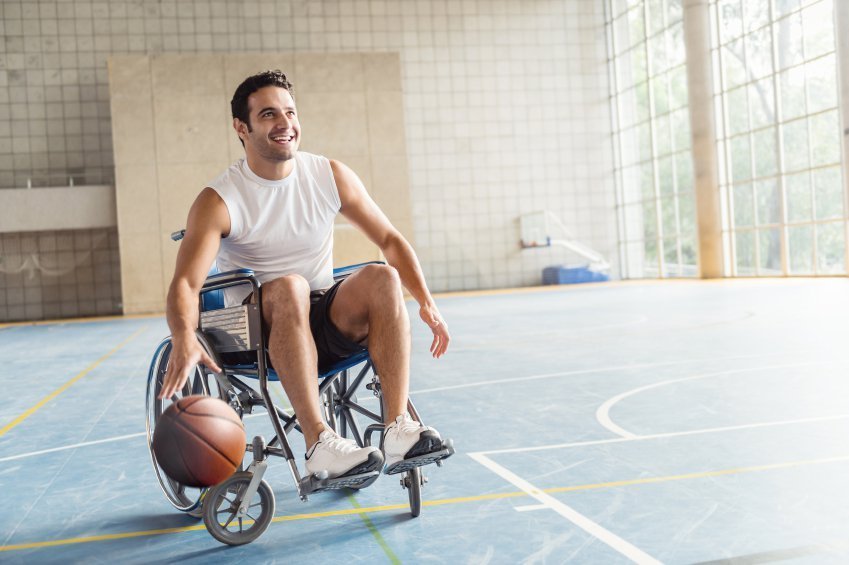
If you’re not ready to refurbish, there are other steps you can take to make your facility more welcoming of people with special considerations. If you’re a gym with regular exercises classes, consider the possibility of designing a wheelchair class. You’d need to hire an experienced instructor and make sure the room where the class will be held is completely accessible. Also consider hosting workshops about exercising with a disability, and see whether you can create areas in your free-weight, cardio, and machine spaces solely for wheelchair users or others who need particular physical accommodations.

In addition, think about how you can make your commitment to inclusivity known. No matter what kind of facility you run, the more you spread the word about your accessibility, and the more you make it known that you welcome all kinds of members, the greater your standing in the community will be, and the more chances you’ll have of attracting an untapped segment of your local population.

Overall, you want to think in terms of being an ally to folks who are differently abled. As an organization dedicated in some form or other to physical activity, you bear a particular onus: how to enable physical activity for everyone. When it comes to issues of accessibility, gyms and sports facilities have a chance to shine.